How to Reduce Energy Consumption in Concrete Block Plants
La Energy costs represent 10-15% of total operating expenses in a precast concrete plant. In many facilities, electricity can account for 60-70% of total utility costs. And most of that consumption is avoidable.
The problem isn't the energy intensity of the manufacturing process itself. The problem is that many plants operate with production lines configured 10 or 15 years ago, when the kWh price was radically different and nobody measured consumption per pallet. Today that kWh costs three times more, and continuing without measuring or optimizing gets expensive every month.
This article gives you a technical roadmap to reduce energy consumption in concrete block plants without compromising production or quality. With diagnosis, concrete interventions, and measurable returns.
Why energy consumption directly impacts profitability
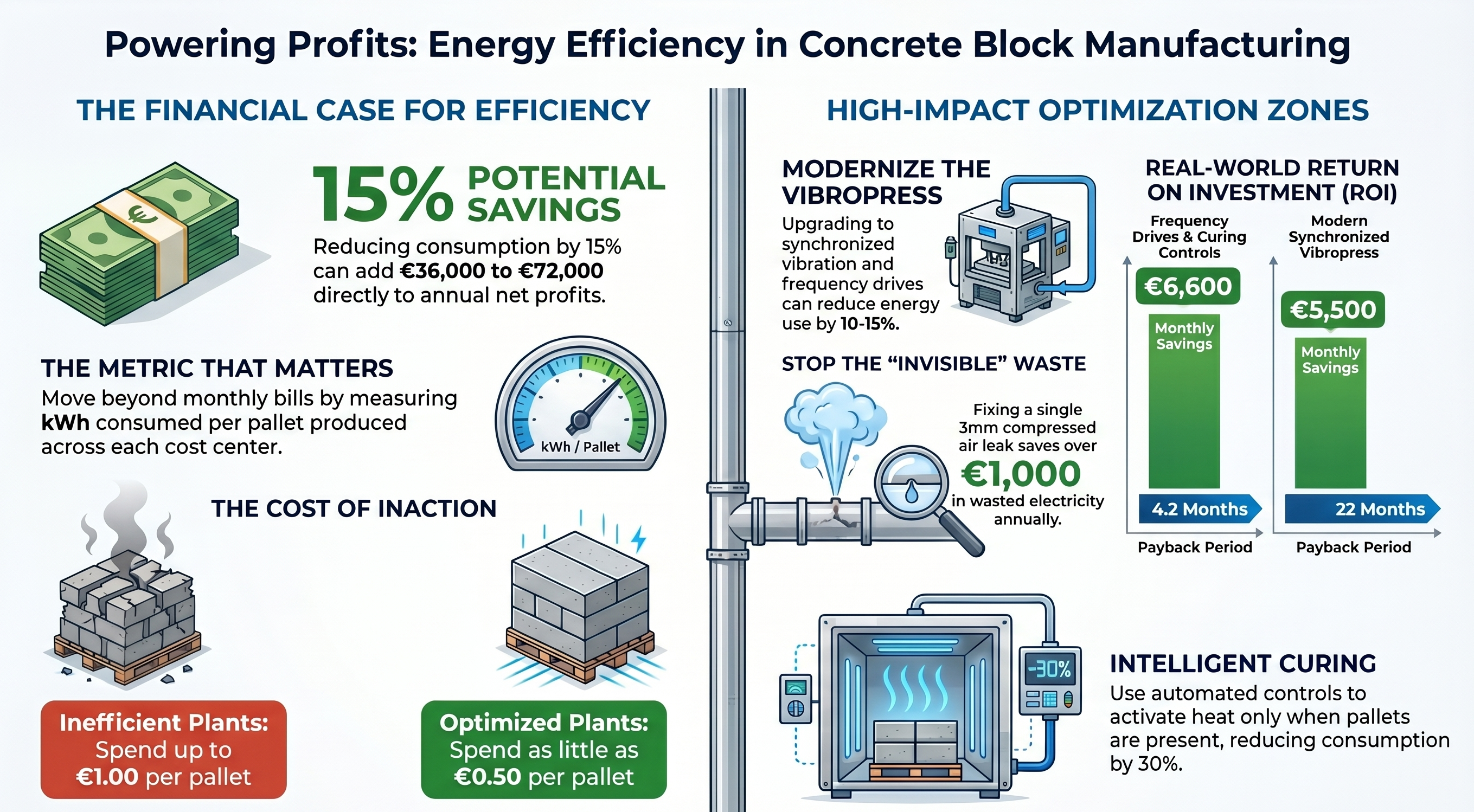
Energy cost per produced pallet is one of the most sensitive indicators when calculating operating margin. A plant producing 40,000 blocks daily can be spending between €0.50 and €1.00 per pallet on electricity alone, depending on installation efficiency.
That means between €20,000 and €40,000 monthly in energy. A 15% reduction in consumption equals savings between €3,000 and €6,000 per month. In a year, you're talking about €36,000 to €72,000 moving from the electricity bill to net income. Without touching sales price or volume.
The pressure comes from two sides. On one hand, industrial kWh prices remain volatile and structurally high in most European markets. On the other, customers demand carbon footprint traceability and environmental certifications. Reducing consumption isn't just immediate profitability—it's also commercial differentiation.
Key areas of energy consumption and how to optimize them
Block machine: the plant's energy heart
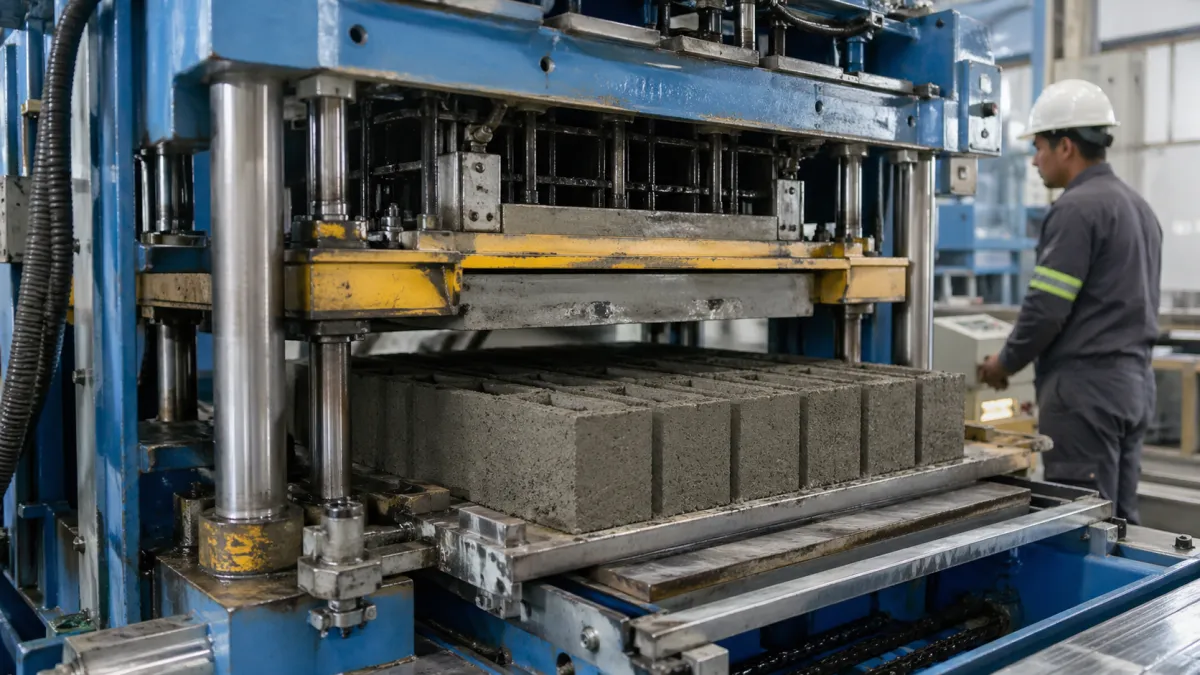
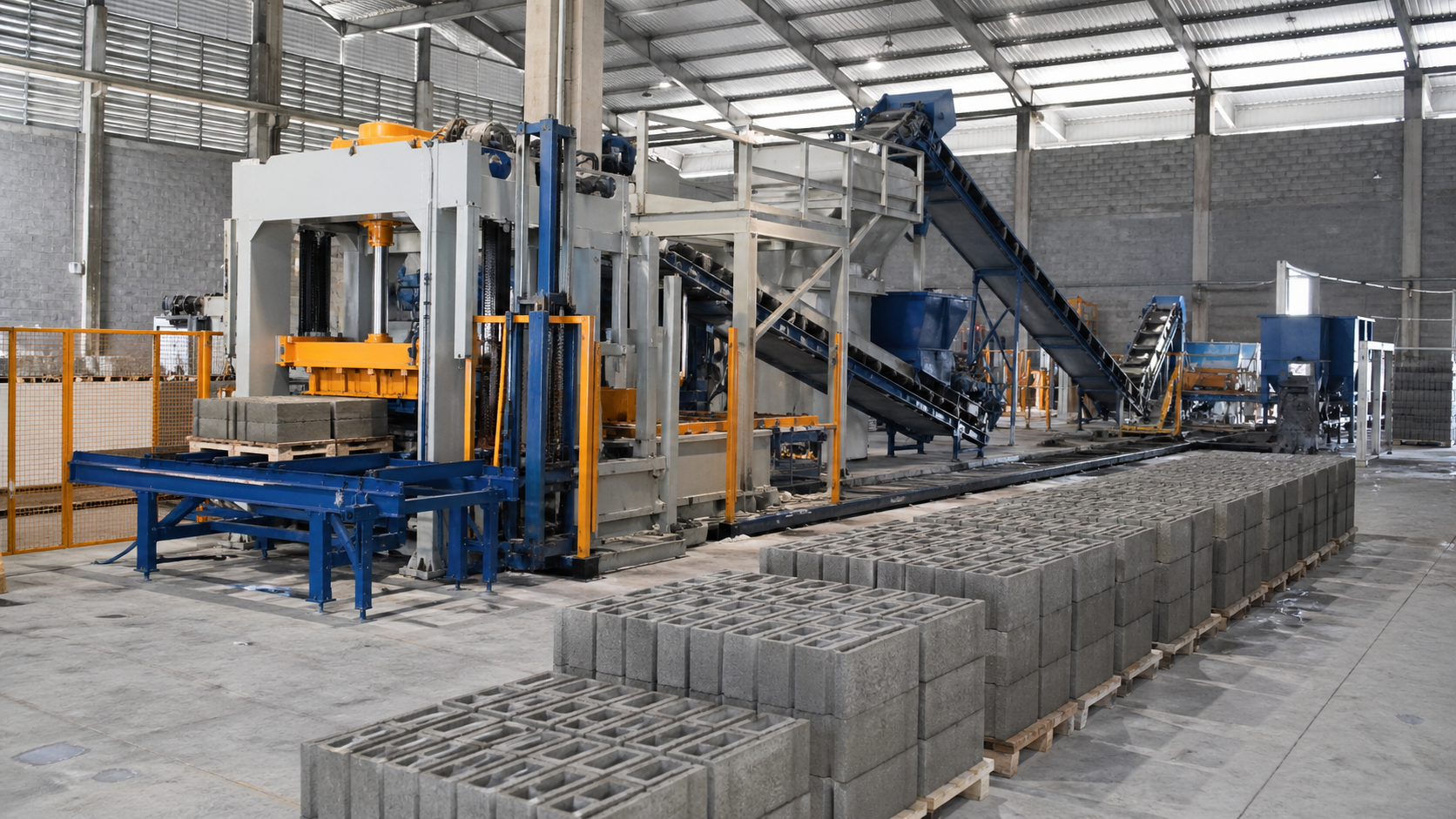
The block machine is the equipment that consumes most energy in a block line. Vibration motors operate at high frequency and with variable loads depending on piece type. This is where an old installation can be wasting up to 20% of energy compared to modern equipment.
The most efficient block machines in the market use a single synchronized vibration motor instead of multiple independent motors. This reduces consumption between 10% and 15% compared to conventional systems. Additionally, frequency drives allow adjusting vibration intensity according to mix and mold, avoiding always working at maximum power.
If your block machine is over 15 years old, a specific energy audit can reveal that updating to an efficient model pays for itself in less than 3 years just with electricity savings. We're not talking about changing the entire line, but modernizing the vibration and control system.
Mixing and batching: precision that saves energy
The mixer consumes energy in two phases: mixing itself and transporting the mix toward the block machine. Many plants operate mixers at constant speed regardless of mix type or material moisture. That generates overwork and unnecessary consumption.
Installing real-time moisture sensors allows adjusting water quantity and mixing time. Less water means less weight to transport and less mixing time to achieve homogeneity. That reduces main motor consumption and also mechanical wear.
High-efficiency motors (IE3 or higher) consume between 5% and 10% less than standard motors. If your plant has 20-year-old motors, replacement pays off quickly. Additionally, efficient motor maintenance is lower because it operates at lower temperatures.
Curing: controlled temperature without waste
Block curing can be natural (air) or accelerated (with steam or heat). If your plant uses thermal curing, there's room to optimize here. Many installations maintain curing chambers at constant temperature all day, even when there's no active production.
A control system that activates curing only when pallets are loaded and adjusts temperature according to concrete recipe can reduce energy consumption in this phase up to 30%. It's also worth reviewing chamber insulation. A poorly insulated chamber loses heat and forces the system to work harder to maintain temperature.
If you use steam, check purges and leaks in piping. A steam leak equals throwing money away every hour. And if the system allows residual heat recovery (for example, to preheat mixing water), savings can be significant.
Compressed air: the invisible expense
Compressed air is one of the most inefficient auxiliary services in any industrial plant. It's estimated that between 20% and 40% of generated compressed air is lost in leaks, deteriorated hoses, and poorly adjusted regulators. In a block plant, compressed air feeds pneumatic cylinders, mold valves, and cleaning systems.
Do a leak audit with an ultrasonic meter. Small leaks are silent but expensive. A 3mm diameter leak can cost over €1,000 per year in wasted electricity. Repair identified leaks and review working pressure: many systems operate at 7-8 bar when they could work perfectly at 6 bar. Each bar reduction saves approximately 7% of energy in the compressor.
Lighting and auxiliary systems
Although not the largest consumer, warehouse lighting can represent between 5% and 10% of total consumption. Replacing old fixtures with LED reduces lighting consumption between 50% and 70%. Additionally, LEDs have longer useful life and require less maintenance.
Auxiliary systems like extractors, fans, and water pumps also have room for improvement. Installing frequency drives in fans and pumps allows adjusting flow according to actual demand instead of running at fixed speed. Savings can reach 30% on this equipment.
Latest generation machinery and its efficiency impact
Technology has advanced. Current block machines and mixers are designed from the start to minimize energy consumption without sacrificing productivity. Modern equipment can produce the same quantity of blocks with 10% less electricity than 15-year-old equipment.
According to industry data, concrete block manufacturing through vibro-pressing requires 10% less electrical energy than other forming methods. But that benefit only materializes if equipment is properly sized and configured.
If you're evaluating machinery renewal, don't just compare purchase price. Calculate total cost of ownership (TCO) including projected energy consumption. Equipment 15% more expensive with 20% lower consumption pays for itself in 4-5 years and then keeps saving every month. In our article about preventive maintenance for concrete machinery we delve deeper into technical criteria impacting operational efficiency.
Water recirculation and its energy impact
Water is another energy consumption vector that many plants ignore. Pumps moving mixing water, cleaning water, and cooling water consume energy. If your plant doesn't recirculate water, you're paying twice: for fresh water and for pumping energy.
A water recirculation system reduces fresh water consumption up to 70% and decreases pumping load. Additionally, recirculated water is already at ambient or slightly elevated temperature, reducing energy needed to bring it to optimal mixing temperature in winter.
Install settlers and filters to recover washing water from mixers and molds. That water can be reused in subsequent cycles without affecting concrete quality, as long as dissolved solids control is maintained.
Real-time monitoring: SCADA and energy control
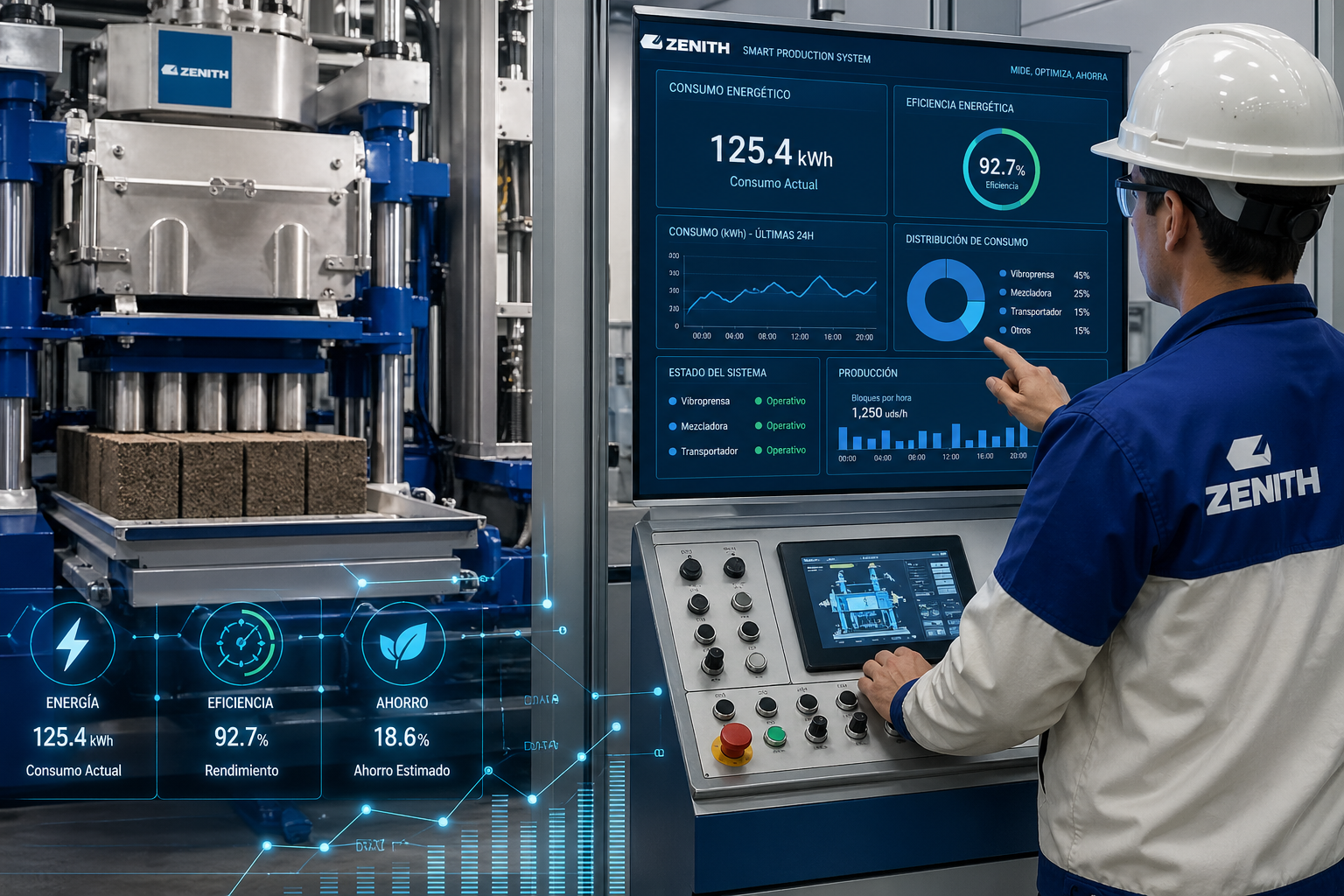
Measuring once a month isn't enough. To truly optimize you need continuous visibility of energy consumption. A SCADA or MES system configured to capture kWh per equipment and per production cycle lets you detect deviations in real time.
If one shift consumes 15% more energy than another producing the same quantity of pallets, there's an operational problem: it could be incorrect adjustment in the block machine, a compressor running unnecessarily, or an operator not following standard procedure. Without real-time data, these problems go unnoticed for months.
Monitoring also allows correlating energy consumption with production variables: block type, mix, ambient humidity, temperature. With that data you can fine-tune recipes and parameters to maximize efficiency without compromising quality. If you're considering a concrete block production process optimization project, integrating energy monitoring should be on the priority list.
Real cases: ROI of energy efficiency investments
The previous numbers sound good in theory, but do they work in practice?
A block plant in central Spain with production of 35,000 blocks/day identified their average consumption was €0.85/pallet. After installing frequency drives on mixer motors and compressor, plus a curing control system, consumption dropped to €0.68/pallet. Savings: €0.17 per pallet. With 35,000 daily blocks (1,750 pallets of 20 blocks), that's approximately €300 daily or €6,600 monthly. Investment in drives and controllers was €28,000. Payback: 4.2 months.
Another case: plant with 18-year-old block machine consuming 42 kWh per cycle. Replacement with modern equipment with synchronized vibration: consumption reduced to 34 kWh per cycle. With 220 daily cycles, daily savings is 1,760 kWh. At €0.12/kWh, that's €211 per day or €5,500 per month. New equipment cost: €180,000. Payback considering only energy savings: 32 months. Adding maintenance reduction and productivity increase, real payback was 22 months.
Checklist para auditar tu consumo energético
Antes de invertir, necesitas saber dónde estás. Esta lista te ayuda a identificar las fugas energéticas más comunes en plantas de bloques:
Medición y línea base:
Tienes medidores eléctricos en cada centro de coste (mezclado, vibroprensa, curado, paletizado).
Conoces el kWh/pallet por tipo de bloque y por receta.
Registras consumo por turno y puedes comparar eficiencia entre operadores.
Vibroprensa:
El sistema de vibración usa variadores de frecuencia.
Los motores de vibración tienen mantenimiento preventivo cada 6 meses.
Se ajusta la potencia de vibración según tipo de mezcla.
Mezclado y dosificación:
Hay sensores de humedad en tiempo real para ajustar agua.
Los motores principales son clase IE3 o superior.
El tiempo de mezclado varía según receta, no es fijo.
Curado:
Las cámaras de curado solo están activas cuando hay producto dentro.
El aislamiento térmico está en buen estado.
Se ha auditado el sistema en busca de fugas de vapor o aire caliente.
Aire comprimido:
Se ha hecho auditoría de fugas en el último año.
La presión de trabajo es la mínima necesaria (no estás sobredimensionado).
Los compresores tienen mantenimiento preventivo regular.
Iluminación:
Más del 70% de la iluminación es LED.
Hay sensores de presencia o temporizadores en zonas de poco tránsito.
Monitorización:
Tienes visibilidad del consumo energético en tiempo real.
Recibes alertas si el consumo se desvía del rango esperado.
Si has marcado menos de 10 casillas, tienes margen de mejora significativo. Y ese margen se traduce en ahorro mensual recurrente.
El coste de no optimizar
Cada mes que pasa sin medir y sin actuar, estás dejando dinero en la factura eléctrica. Si tu planta consume 0,80 €/pallet y con optimización podría bajar a 0,65 €/pallet, el diferencial de 0,15 € por pallet se acumula rápido. Con 30.000 bloques diarios (1.500 palets) durante 20 días laborables al mes, estás perdiendo 4.500 € mensuales. En un año: 54.000 €.
Eso es dinero que podría ir a renovación de moldes, formación de personal, o simplemente a mejorar márgenes. La eficiencia energética no es un proyecto de sostenibilidad desconectado del negocio. Es gestión industrial básica con impacto directo en cuenta de resultados.
Además, los costes energéticos tienden al alza. Cada año que postpones la optimización, el diferencial en euros se amplía. Y mientras tanto, tu competencia que sí optimizó tiene costes operativos menores y puede ser más agresiva en precio o más rentable con el mismo precio.
Optimiza tu consumo energético hoy
Reducir el consumo energético en plantas de bloques de hormigón no requiere parar producción ni rehacer toda la instalación. Requiere diagnóstico técnico, priorización de intervenciones por ROI y ejecución ordenada. Las plantas que miden, ajustan y monitorean su consumo energético operan con costes entre un 15% y un 25% más bajos que las que nunca han auditado su eficiencia.
El primer paso es saber dónde estás. Mide tu kWh/pallet durante dos semanas y compara con los rangos de referencia del sector. Si estás por encima de 0,70 €/pallet, hay oportunidades claras de mejora. Si estás por encima de 0,90 €/pallet, la mejora es urgente.
En CBM Experts trabajamos con plantas de todo el mundo para identificar ineficiencias energéticas y diseñar planes de mejora con retorno medible. Si quieres una evaluación inicial de tu consumo y una propuesta de optimización sin coste:
👉 Rellena nuestro formulario para una evaluación técnica inicial.
👉 Solicita presupuesto y un plan faseado de CBM Experts para optimizar tu final de línea sin parar la planta.