
Concrete block production process: stages, equipment and key variables
Stages, equipment and key variables
Every vibrocompacted block that leaves a plant is the result of a sequence where machinery, raw materials and process parameters intersect within very tight time windows. A two-point error in aggregate moisture can push dimensional variation out of spec. A vibration cycle half a second shorter than required can compromise the compressive strength of an entire day's output.
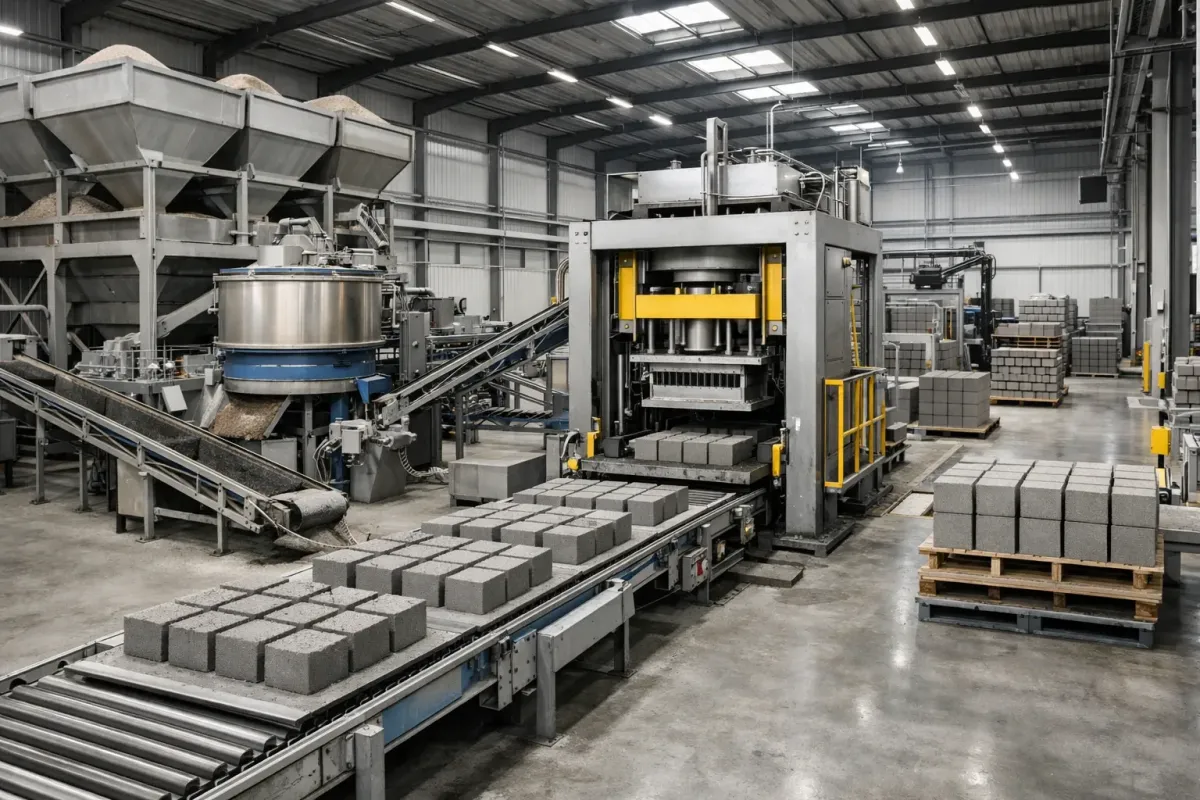
The concrete block production process breaks down into five distinct stages: batching and mixing, vibrocompaction, green product handling, curing and palletizing. Each one depends on specific equipment and variables that a technical manager needs to control with data, not instinct.
What follows is the full walkthrough of a concrete block production line, from the aggregate hopper to the finished pallet, with a focus on what each machine does and why each parameter matters.
Table of contents
Stages, equipment and key variables
Batching and mixing: the first point where quality is won or lost
Water-to-cement ratio in semi-dry mixes
Moisture sensors and real-time recipe control
The block machine: compaction, vibration and cycle time
Critical vibration and pressure parameters
The role of the mold in dimensional accuracy
Press exit and green product handling
Curing: temperature, humidity and dwell time
Batching and mixing: the first point where quality is won or lost
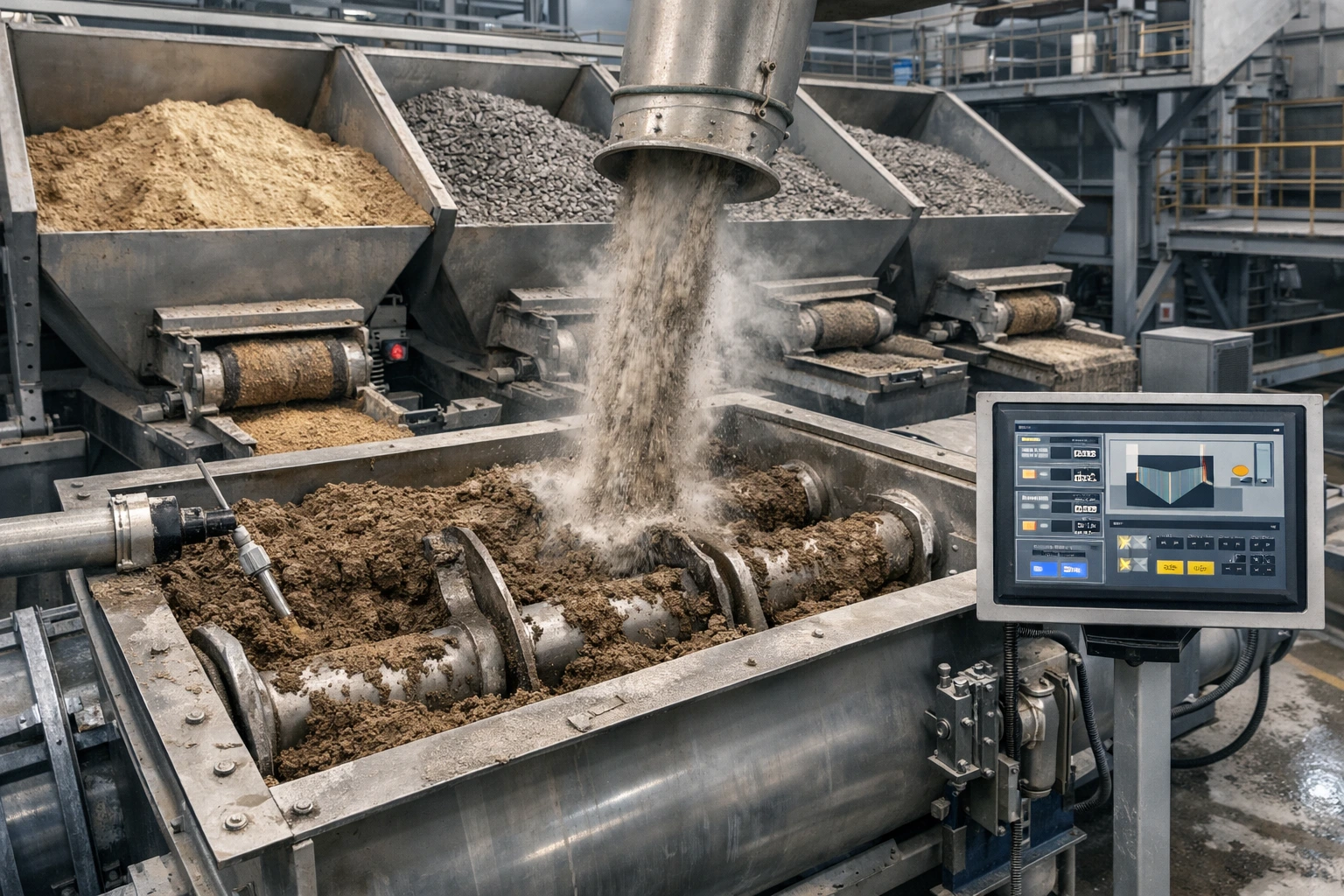
Block quality is defined before the mix ever reaches the press. Dry-mix batching for concrete blocks works with earth-damp consistency mixes, very different from conventional wet-cast concrete.
Typical proportions range between 6:1 and 8:1 aggregate-to-cement by weight, with moisture content that rarely exceeds 7–8 % of total mix weight. Within that narrow margin, any deviation translates into downstream problems: blocks that slump when stripped from the mold, surfaces with open pores, or strengths that fail to meet specification.
The batching system in a modern concrete block plant uses hoppers with load cells for each aggregate (sand, gravel, chip) and screw feeders or weigh hoppers for cement. Weighing accuracy is critical: tolerances of ±1 % for cement and ±2 % for aggregates are standard on well-calibrated equipment.
Discharge goes into the mixer, which may be single-shaft, twin-shaft or planetary, with mixing times between 60 and 120 seconds depending on design.
Water-to-cement ratio in semi-dry mixes
The water-to-cement ratio in vibrocompaction mixes sits between 0.30 and 0.40, well below the values common in plastic concrete. Water serves two purposes: activating cement hydration and providing the minimum cohesion for the mix to compact without crumbling during stripping.
Too much water and the block deforms under its own weight on exit from the mold. Too little and compaction falls short, leaving internal voids that reduce strength and durability.
Experienced operators often gauge mix moisture by squeezing a handful: if it holds shape without wetting the fingers, it is in range. But relying on that manual criterion introduces variability between shifts and operators. Plants that pursue consistency migrate toward automatic control, and that is where sensors come in.
Moisture sensors and real-time recipe control
Microwave sensors installed in the mixer measure aggregate moisture every cycle with ±0.3 % accuracy. The control system corrects mixing water automatically, compensating for moisture variations the aggregate brings from the stockpile (which can swing between 2 % and 8 % depending on rainfall, irrigation or material source).
A properly configured recipe control system logs every batch: actual weights, mixing time, measured moisture and water added. That traceability allows quality issues to be correlated with specific batches and decisions to be based on real data rather than assumptions. It is the same logic behind applying quality control best practices to concrete block production: measure, record, correct.
The block machine: compaction, vibration and cycle time
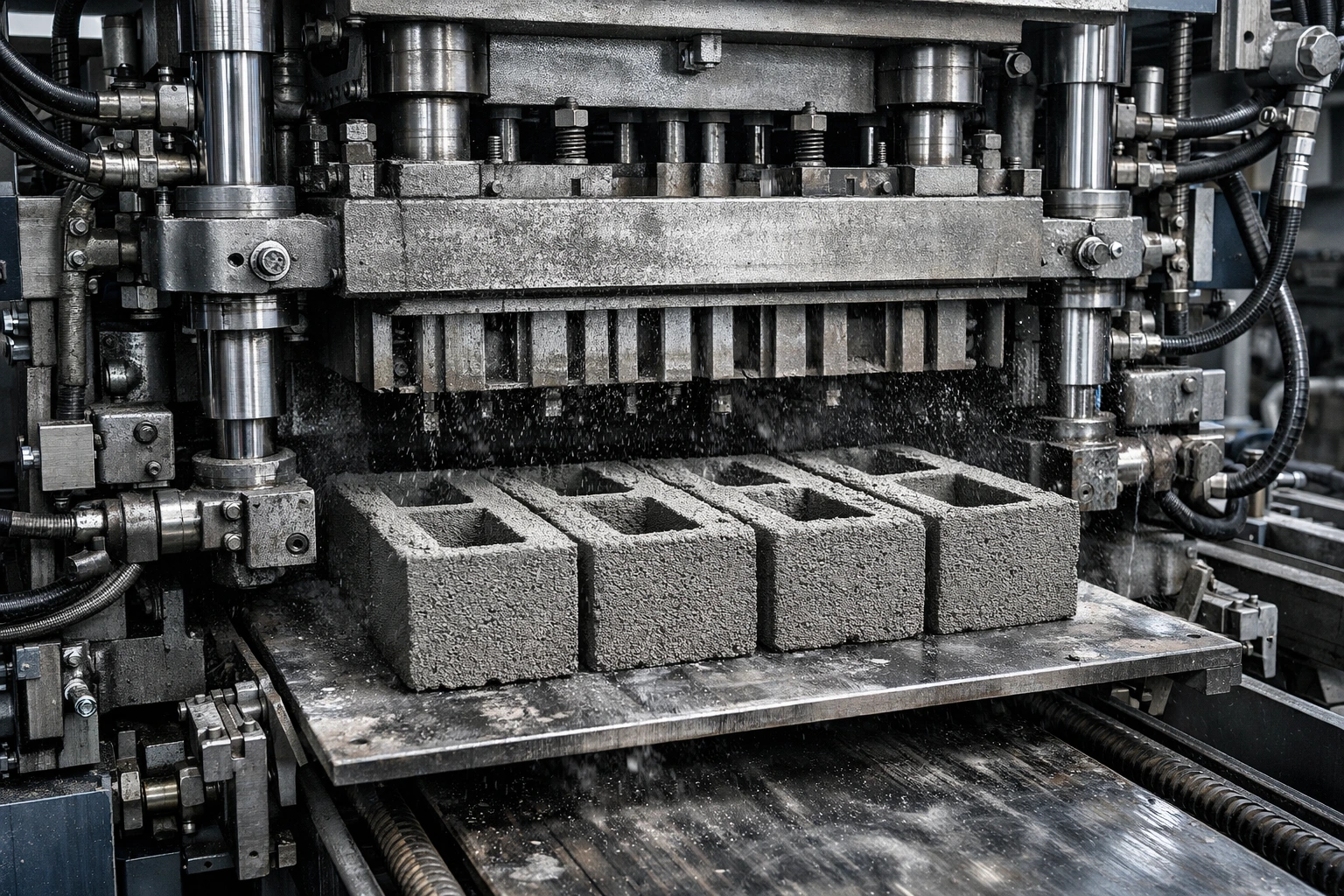
The concrete block machine is the heart of the line. Its function appears straightforward: fill a mold with mix, vibrate and compact to shape the block, and strip onto a production board. But the reality is that the pressing cycle concentrates more critical variables per second than any other stage of the process.
A full vibrocompaction cycle lasts between 6 and 15 seconds, depending on block type and press capacity.
Within that interval three phases occur: mold feeding (the feed box fills the cavities), vibration with pressure (the vibrators compact the mix while the tamper head descends under force) and stripping (the tamper rises and the mold lifts, leaving the blocks on the production board). Each phase has tight tolerances.
Critical vibration and pressure parameters
Vibration is defined by frequency (between 3,000 and 6,000 rpm depending on manufacturer and product), amplitude (from 0.5 to 1.5 mm) and resulting centrifugal force. High frequency with low amplitude produces blocks with good surface finish but potential lack of internal compaction.
High amplitude with low frequency compacts the core well but can cause segregation and rough surfaces. The balance depends on the mix type, the mold and the target product.
Tamper pressure combines with vibration to densify the mix. High-end hydraulic presses allow pressure and descent speed to be regulated independently, giving flexibility to produce anything from 8-inch hollow blocks to solid pavers on the same machine. The technical manager who masters the vibration-pressure-time combination reduces rejects and improves line OEE.
The role of the mold in dimensional accuracy
The mold defines block geometry: external dimensions, wall thickness, core shapes. A mold manufactured from high-strength steel with nitriding treatment can produce between 500,000 and 1,000,000 blocks before exceeding allowable dimensional tolerances. Mold wear is progressive and measurable, which is why tracking accumulated cycles matters.
Changing molds to switch from one product to another (for example, from an 8-inch block to a 6-inch block) is one of the most common scheduled stops in a plant. Applying techniques like SMED to mold changeovers reduces downtime and increases press availability — and the press is the natural bottleneck of the entire line. A solid preventive maintenance program for your concrete machinery keeps mold wear under control and changeover times predictable.
Press exit and green product handling
The freshly stripped block has minimal mechanical strength. The compacted mix holds its shape thanks to residual cohesion and confinement, but a bump, a sudden acceleration during transport, or an irregularity on the board can cause cracks, chipped edges, or deformations that turn valid pieces into rejects.
The transport system between the press and the curing chamber (finger car, transfer car, elevator) must move boards carrying green blocks smoothly and at controlled speed. Well-designed equipment works with progressive acceleration and deceleration, centering guides and position sensors that prevent impacts.
The distance between the press and the curing elevator should be kept to a minimum to reduce green product exposure to air drafts or temperature changes that cause premature surface drying.
This stretch of the line may seem minor, but plants that neglect green product handling generate between 2 % and 5 % additional rejects without the cause being captured in any quality report. Checking the condition of production boards (flatness, cleanliness, wear) is part of the maintenance that separates a plant that runs from one that loses margin.
Curing: temperature, humidity and dwell time
Curing concrete blocks is the stage that transforms a fragile piece into a block with structural strength. Cement hydration requires specific temperature and humidity conditions to develop strength predictably. Without curing control, results depend on outdoor weather: in summer the plant produces different blocks than in winter, and that variability generates complaints.
Industrial curing chambers maintain relative humidity above 90 % and temperatures between 40 °C and 60 °C (104–140 °F) for 8 to 24 hours, depending on target strength and cement type.
Heat accelerates the hydration reaction: every 10 °C increase above ambient temperature can double the rate of strength gain in the first hours. But overly aggressive curing (temperatures above 70 °C or steep thermal gradients) generates internal microcracking that compromises long-term durability.
The investment in curing chambers is justified on two fronts: quality consistency (uniform blocks regardless of season) and board rotation (faster curing means boards return to the press sooner, increasing daily output without adding more boards to the circuit). For a deeper look at the specifications blocks must meet after curing, the industry reference is the ASTM C90 standard as documented by the Concrete Masonry & Hardscapes Association (CMHA), which defines requirements for strength, absorption and linear shrinkage.
Palletizing and line exit
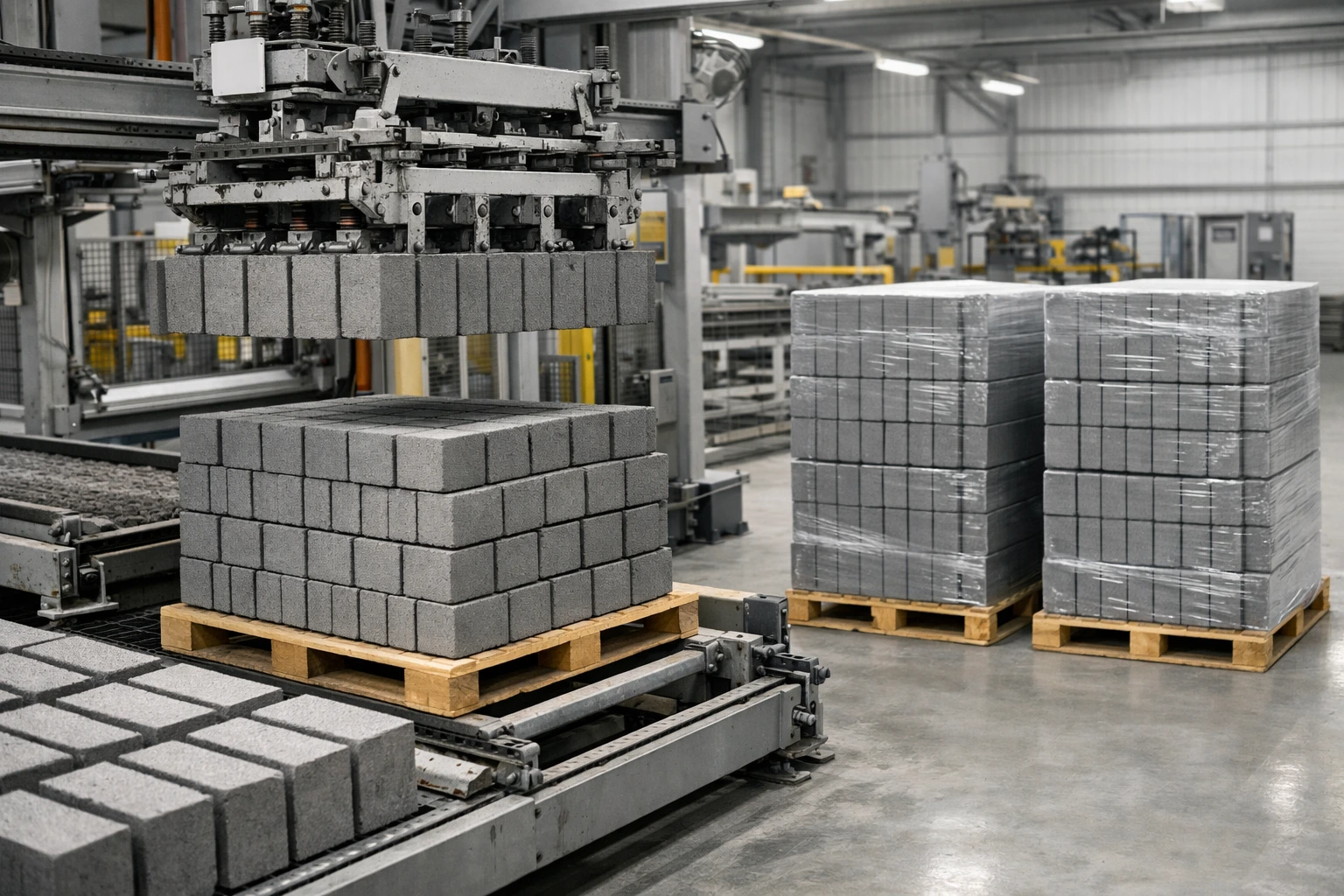
Automatic concrete block palletizing closes the production cycle. Once cured, blocks exit the chamber, are de-stacked from production boards and grouped in layers on timber or PVC pallets. Modern palletizing equipment uses hydraulic or pneumatic clamps that grip full rows of blocks, rotate them if the pattern requires it (cross-bonding for pallet stability) and place them without impact.
A well-integrated palletizer produces between 3 and 6 layers per minute, depending on block format and stacking pattern. Subsequent strapping or stretch-wrapping prepares the pallet for outdoor storage and transport.
Plants that automate this stage eliminate manual handling of blocks weighing between 10 and 25 kg (22–55 lb) each, reduce back injuries among staff and gain evacuation speed, preventing the palletizer from becoming a brake on the press.
The production board, once free of blocks, returns to the press to start a new cycle. The complete board circuit (press → curing → de-stacking → return) sets the real production rate of the plant, above and beyond the theoretical speed of the press.
Common bottlenecks in the line and how to measure them
How concrete blocks are manufactured efficiently does not depend solely on having good equipment. It depends on no single point in the line slowing down the rest. The most frequent bottlenecks in a block plant are:
Slow or inconsistent mixing: if the mixer takes longer than the press cycle, the block machine waits empty. The key indicator is the percentage of cycles in which the feed box receives mix on time.
Press cycle limited by the mold: molds with many cavities or complex geometries extend filling and vibration time. Recording actual cycle time and comparing it with the manufacturer's theoretical figure shows the deviation.
Curing as a board limiter: if the chamber lacks sufficient capacity or the curing cycle is long, boards do not rotate fast enough and the press stops for lack of empty boards. The ratio of boards in circulation to boards needed per press-hour reveals whether the bottleneck is here.
Manual or semi-automatic palletizing: in plants with manual palletizing, evacuation speed drops by half and the press accumulates full boards with no outlet.
Measuring OEE (availability × performance × quality) for the complete line, not just the press, gives visibility into where production is lost. Once the bottleneck is identified, the decision to invest in a specific piece of equipment has data to back it up.
Your production line, optimized from end to end
Every stage of the concrete block production process has variables to control, equipment to size and decisions to make with direct impact on block quality, cost per unit and actual plant capacity. The difference between a line that runs and one that performs lies in the technical details of each section.
If you are evaluating upgrading your plant, expanding capacity or solving a recurring quality issue, CBM Experts can help. We design and manufacture complete block production lines, from batching to palletizing, and work with your technical team to tune every parameter to your real-world conditions:
👉 Fill out our form for an initial technical assessment.
👉 Request a quote and a phased plan from CBM Experts to optimize your end of line without stopping the plant.