

Curing chambers for vibrocompressed blocks
T-HR profiles, uniformity, ventilation, heat recovery and monitoring
If you run a block plant, the performance and appearance of your units depend on curing, here you will see how to design and operate curing chambers for vibrocompressed blocks with well-defined temperature and humidity profiles (T-HR), maximum uniformity, effective ventilation, heat recovery and reliable T/RH monitoring to ensure quality and reduce energy use.
Table of contents
T-HR profiles, uniformity, ventilation, heat recovery and monitoring
Curing controls the microstructure… and your EBITDA
T-HR profiles (temperature and relative humidity) in block curing
Profile structure: 4 practical phases
Plateau or “soak” at target T-HR
Operating ranges that cut energy without sacrificing quality
Thermal and humidity uniformity: how to really achieve it
How to measure uniformity without fooling yourself
Ventilation and air circulation in curing chambers
Heat recovery: from sunk cost to operational advantage
Heat from compressors and auxiliary equipment
Make-up air from the chamber itself
Monitoring concrete curing: T and RH sensors that do not fail at 98% RH
Sensor selection and installation
Where to measure to control the process, not just report
Calibration, maintenance and data
Typical case: from “hotter and faster” to mild, controlled profiles
Integrating curing with the rest of your “factory system”
Actionable checklist: curing chambers for vibrocompressed blocks
FAQs — Common questions about block curing and how to solve them
Can I use the same T-HR profile all year round?
When should I choose steam over hot air?
Which metrics should I track to know if the chamber is “in shape”?
What measurement error is most common at high RH?
Curing controls the microstructure… and your EBITDA
Vibrocompaction gives you density and shape; curing finishes the job. Cement hydration, controlled heat dissipation and maintaining sufficient relative humidity determine early strengths, color, edges and efflorescence.
The technical definition of curing makes it clear: “maintaining temperature and humidity conditions so that hydration reaches the design performance.”
At CBM Experts we see it every week: plants with the same vibropress but opposite results because of their chambers. The difference is not in “curing more” but in curing better: T-HR profiles adapted to the product, zero stratification, air that circulates where it should and real-time data.
T-HR profiles (temperature and relative humidity) in block curing
Designing the T-HR profile means deciding when you add heat, how much humidity you retain and at what rate you change the environment. It must vary by family (structural block, paver, split, colored block) and by climate.
Profile structure: 4 practical phases
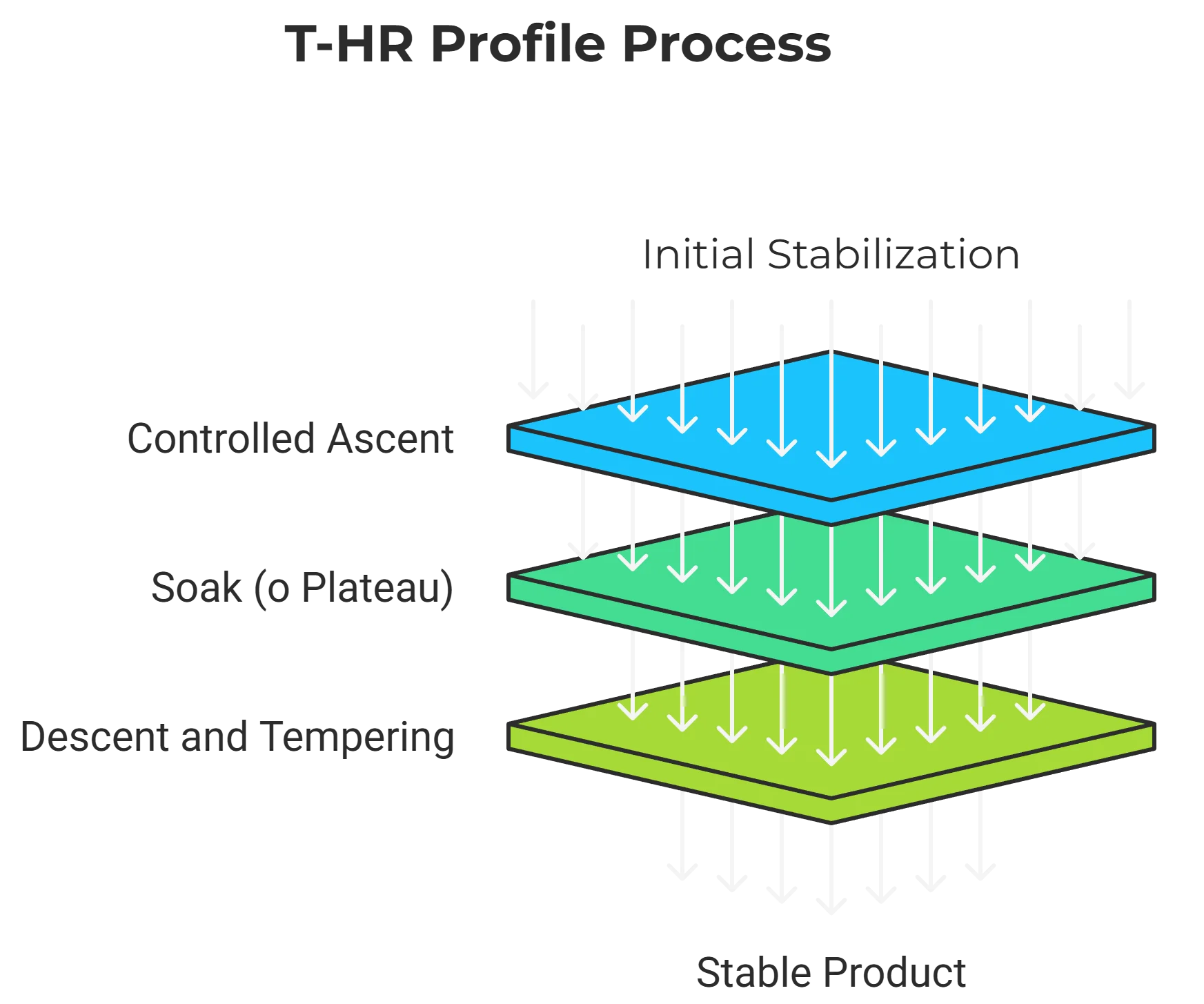
Preconditioning
Objective: stabilize T-HR before the first rack enters. Bring the chamber to setpoint with dampers closed and fans on low. You avoid “thermal shocks” to the initial load.
Controlled ramp-up
Raise temperature with a known slope and high humidity to protect edges and minimize internal gradients. In hot-air processes, typical commercial heating capacity is in the range of 10–20 K/h depending on product and molds; this guides reasonable ramps.
Plateau or “soak” at target T-HR
Here you consolidate strength and appearance. In vibrocompressed block production, moderate setpoints work very well, because they reduce energy use and homogenize color.
Cool-down and tempering
Lower temperature gradually and enable air renewal to remove moisture without shock. Product leaves “dry to the touch,” stable for palletizing and wrapping.
Operating ranges that cut energy without sacrificing quality
Industrial evidence in chambers for precast and block recommends working between 25–35 °C. Each additional degree of setpoint increases energy consumption by ~5%; in addition, hydration itself can self-heat the chamber to 25–28 °C in large volumes.
Key point: do not copy recipes from cast-in-place concrete; your units are thin, dense and with large exposed surfaces. Mild profiles, high RH at the start and intelligent ventilation usually beat steam “blasts” or temperature spikes.
Thermal and humidity uniformity: how to really achieve it
Uniformity is not a pretty number on the screen; it is minimal dispersion within each rack, between lanes and over the height of the chamber. When the bottom is 5–8 °C colder than the top, you bleach some units and darken others, open pores and increase scrap.
What really moves the needle
Insulation and tightness. Sandwich panels with PUR/PIR core, doors with good sealing and floors without infiltrations. Improvements here cut losses and stabilize the vertical gradient. BFT documents how switching to 100 mm panels significantly reduces envelope losses.
Well-sized and well-oriented fans. It is not “more airflow” but pattern: recirculation that sweeps through the load, not just along corridors.
Supply and return. Distributed supply plenums, low-level returns to break stratification, dampers that balance sectors.
Load and layout. Stack heights, spacing between pallets and racks, and “dead zones” near walls.
How to measure uniformity without fooling yourself
Quarterly T-HR mapping with a network of probes at representative heights and aisles.
A/B testing: two twin racks, one in a “difficult” zone and another in a “prime” zone; compare initial strength, color and absorption.
Dispersion KPIs: P10–P90 percentiles of T and RH per cycle, not just the average.
Ventilation and air circulation in curing chambers
Circulation prevents layers of hot air at the roof and cold air at the floor. BFT sums it up: poor recirculation = stratification and more energy to heat the lower level where the units are. Good recirculation = consistent hardening and higher quality.
Practical flow design
Top supply, bottom return, with deflectors that push through the load.
Zoning: not all areas need the same airflow. Modulating valves and dampers by sector.
Smart bypass to stabilize airflow when you close make-up air.
Avoid short-circuits: if the air returns to the intake without passing through racks, you will have heated the wall, not the product.
Steam, hot air or hybrid?
Hot air with fan-coils and blowers offers smooth ramps and great spatial control; commercial systems use it in rigid chambers with low product diversity, such as blocks and pavers.
If you use low-pressure steam, control injection and mix it with recirculated air so you do not “soak” the load at localized inlets.
Heat recovery: from sunk cost to operational advantage
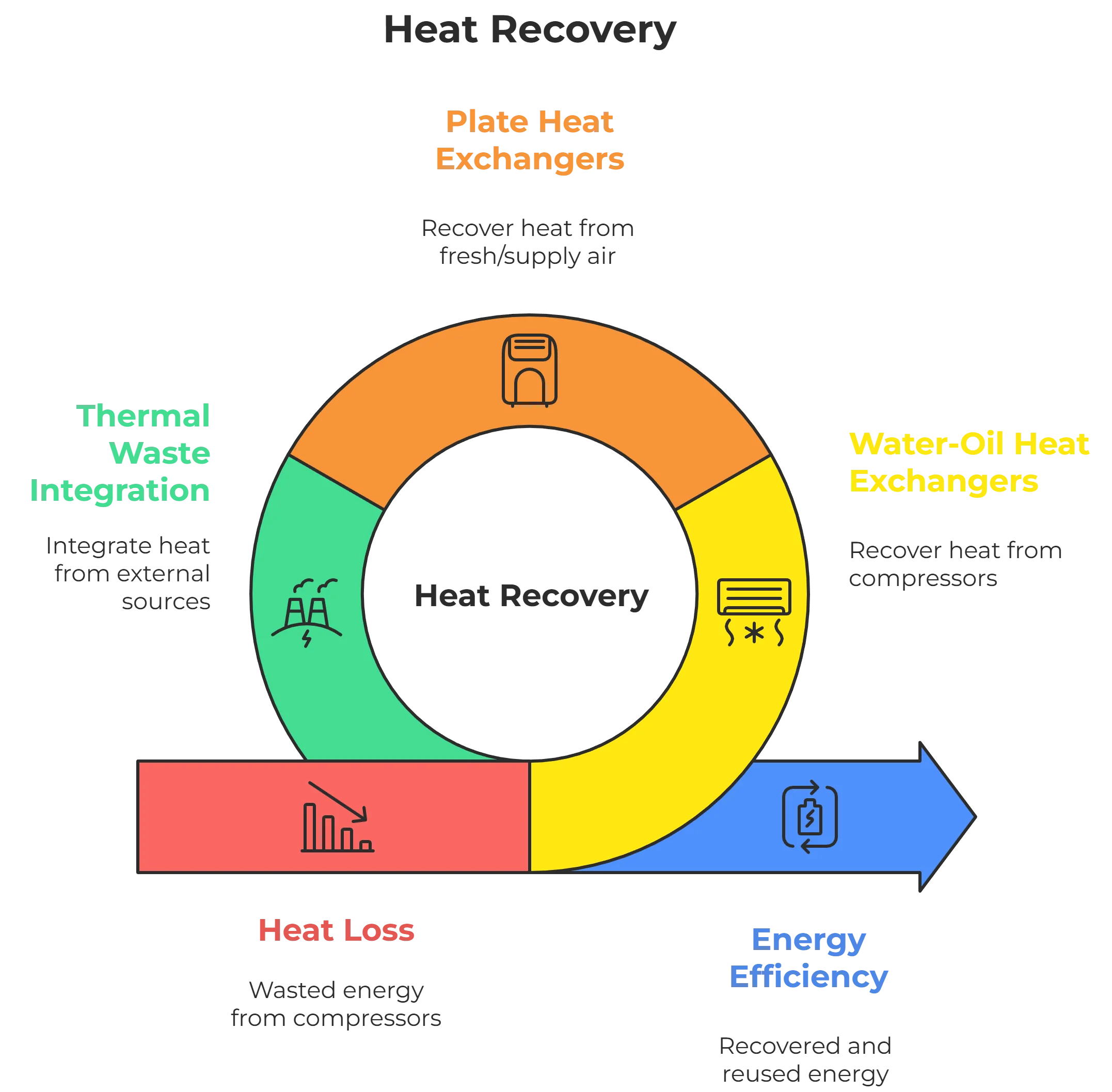
Curing chambers are perfect for reusing nearby heat. Three return sources with fast ROI.
Heat from compressors and auxiliary equipment
Up to ~90% of compressor energy is lost as heat and can be recovered with water-oil heat exchangers and fed into the chamber circuit. Typical paybacks are 12–18 months in European plants. BFT details the potential and recovery equipment ready for retrofitting.
Make-up air from the chamber itself
If you ventilate to control RH, recover that heat with cross-flow plate heat exchangers and return it to the chamber (up to ~75% of the energy), reducing the required auxiliary power. BFT, 2024.
Mixed with external sources
Modern systems integrate waste heat from boilers, biomass or even “waste heat” from processes. A modular approach allows you to use a heat pump with high COP at temperatures of 25–40 °C, ideal for mild setpoints. BFT confirms this and highlights the efficiency compared to condensing boilers.
Monitoring concrete curing: T and RH sensors that do not fail at 98% RH
The ideal chamber without data is a myth. You need T and RH in real time with sensors that can withstand high humidity, intermittent condensation and dust.
Sensor selection and installation
Use capacitive probes for RH with an option for a heated sensor or “warmed probe” in environments >90–100% RH to prevent condensation and unstable readings.
Place the probe inside the chamber and in thermal equilibrium with the air, avoiding the sensor body being outside and creating a gradient. This recommendation is reinforced by application notes on climatic chambers.
Temperature with protected PT100/RTD sensors and, if there is steam, sintered filters.
Where to measure to control the process, not just report
Heights: floor, mid-height and top of chamber.
Critical aisles: air inlet, return and historically cold zones.
In the load: a couple of probes inserted into “witness” pallets per campaign to validate that the air you control actually reaches the product.
Calibration, maintenance and data
Annual calibration (or semi-annual in 24/7 shifts), with in-situ verification using brines or “hot-swap” replacement.
Alarms based on deviation from setpoint and rate of change (dT/dt and dRH/dt), not just absolute values.
Traceability: integrate sensors and recipes into the plant SCADA/MES to relate curing to scrap by batch and color/absorption. If you are already in the process of modernizing the factory, see our guide on how to modernize a concrete block plant for an orderly OT/IT rollout.
Typical case: from “hotter and faster” to mild, controlled profiles
Situation: plant with two-layer pavers. Chamber without heat recovery, unbalanced fans.
Defects: tone differences between rows and microcracks on edges.
Interventions:
Sealing leaks and make-up air with a heat recovery unit.
Change of ventilation pattern with deflectors and low-level return.
T-HR profile: plateau at 30–32 °C and high RH in the first hours.
Monitoring with heated probes in cold zones.
Results: same cycle time, -14% energy/pallet, -38% scrap due to color. This enables palletizing without waiting and closing the shift. If you want to go deeper into end-of-line, see our article on automatic palletizing in precast.
Integrating curing with the rest of your “factory system”
Curing does not live in isolation. If the molds generate dimensional variability, the chamber will not fix it; it will only make it visible. To learn more, we invite you to consult what Kobra molds are and how to choose them to understand tolerances and treatments.
The same applies to availability: a perfect chamber does not compensate for vibropress downtime. Spare-parts policies on critical equipment, especially those from brands widely present in the market, reduce MTTR and protect your planned curing profile.
Actionable checklist: curing chambers for vibrocompressed blocks
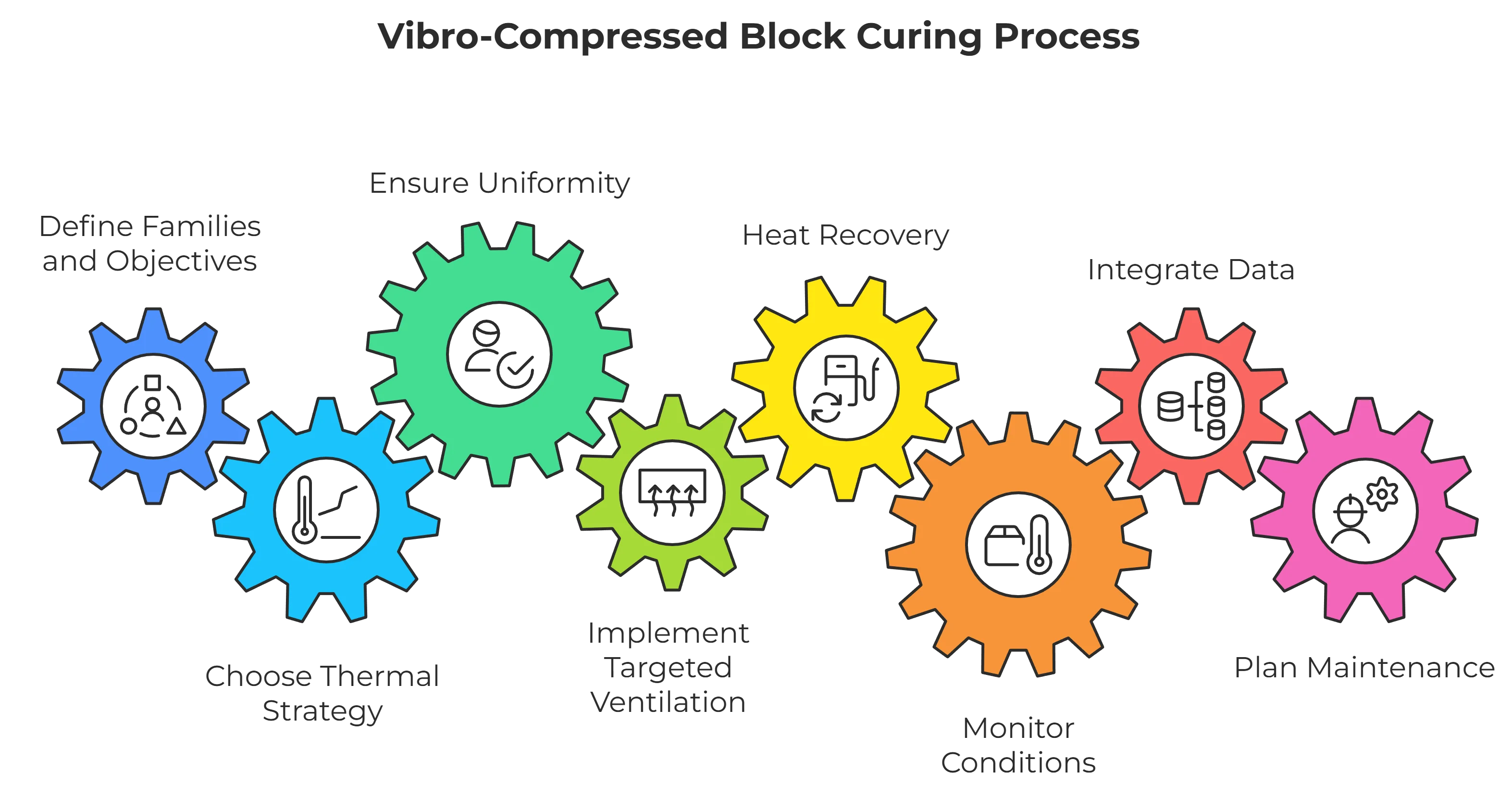
Define families and objectives: early strength, color, absorption, palletizing plan.
Choose thermal strategy: 25–35 °C setpoints and high RH at the start. Adjust ramps according to mass and geometry.
Uniformity first: insulate, seal and correct stratification with low-level return and deflectors.
Directed ventilation: blow through the load; modulate by zones; avoid short-circuits.
Recover heat: compressors, chamber make-up air and heat pumps for mild setpoints. Short ROI.
Monitor properly: T-HR probes suitable for high humidity, installation in thermal equilibrium and rate-of-change alarms.
Integrate data with production: curing recipe by SKU in SCADA/MES and monthly audit of T-HR dispersion.
Maintenance plan: filter cleaning, planned calibration, damper checks and recovery tests.
FAQs — Common questions about block curing and how to solve them
Can I use the same T-HR profile all year round?
No. Adjust setpoints, ramps and make-up air according to outdoor temperature, aggregate moisture content and product type. Maintain summer/winter profiles and activate auto-adjustment based on RH measured in the chamber.
When should I choose steam over hot air?
Steam accelerates curing and provides very high RH at the start, useful for delicate units or cold climates; hot air offers better spatial control and efficiency for blocks and pavers. Combining them is often optimal: targeted steam at the start and hot air for the plateau.
Which metrics should I track to know if the chamber is “in shape”?
Energy/pallet, T and RH dispersion P10–P90 per cycle, dT/dt during ramp-up and time to demolding/palletizing without rework.
What measurement error is most common at high RH?
Condensation on the probe and a thermal gradient if part of the sensor body is outside the chamber. Solution: heated probe and installation 100% in thermal equilibrium.
How can I scale without stopping the plant?
Phase by modules, create temporary bypasses and use “compatible” profiles with the existing chamber during the transition.
Less temperature and more control
In curing, less temperature and more control usually wins: mild T-HR profiles, air that circulates through the product, tight chambers with heat recovery and robust T/RH sensors.
When you standardize, you reduce erratic colorimetry, shorten chamber time and free up palletizing.
If you want us to review your chamber or design the retrofit, at CBM Experts we guide you step by step all the way to measurable ROI:
👉 Fill out our form for an initial technical assessment.
👉 Request a quote and a phased plan from CBM Experts to optimize your end of line without stopping the plant.