Regulations and Certifications for Machinery for Precast Concrete: What You Must Comply With in 2026
Regulations and Certifications for Machinery for Precast Concrete: What You Must Comply With in 2026
Legal Framework Applicable in 2026
1. Directive 2006/42/EC (in force in 2026)
2. Regulation (EU) 2023/1230 on machinery
CE Marking in Precast Concrete Machinery: Real Implications on the Plant Floor
Machine, partly completed machinery and complete line: key distinctions
Responsibility of the Integrator
Substantial Modification: When Responsibility Changes
Common Harmonised Standards in Precast Machinery
EN ISO 13849 – Safety of Control Systems
EN 60204-1 – Electrical Equipment of Machines
Regulation (EU) 305/2011 (CPR) and Its Indirect Impact on Precast Machinery
EN 13369 and the Common Framework for Precast Products
Factory Production Control (FPC): What It Means for Machinery
Key Distinction: Machinery vs Construction Product
What a Precast Machinery Manufacturer Should Review in 2026
1) Risk assessment: review it, do not archive it
2) Clearly define the scope of conformity (machine vs line)
3) Safety-related control systems (software and logic)
4) Technical documentation: prepare it for digital transition
5) Parameter traceability: increasingly less “optional”
6) After-sales and on-site changes: controlling “substantial modifications”
Frequently Asked Technical Questions (FAQ)
Is CE marking mandatory for precast concrete machinery?
What exactly changes with Regulation (EU) 2023/1230 and why does it already matter in 2026?
Does used machinery need to “adapt” to the new Regulation?
What documentation must actually exist for CE marking to be defensible?
Why is CPR 305/2011 relevant if I manufacture machinery, not precast products?
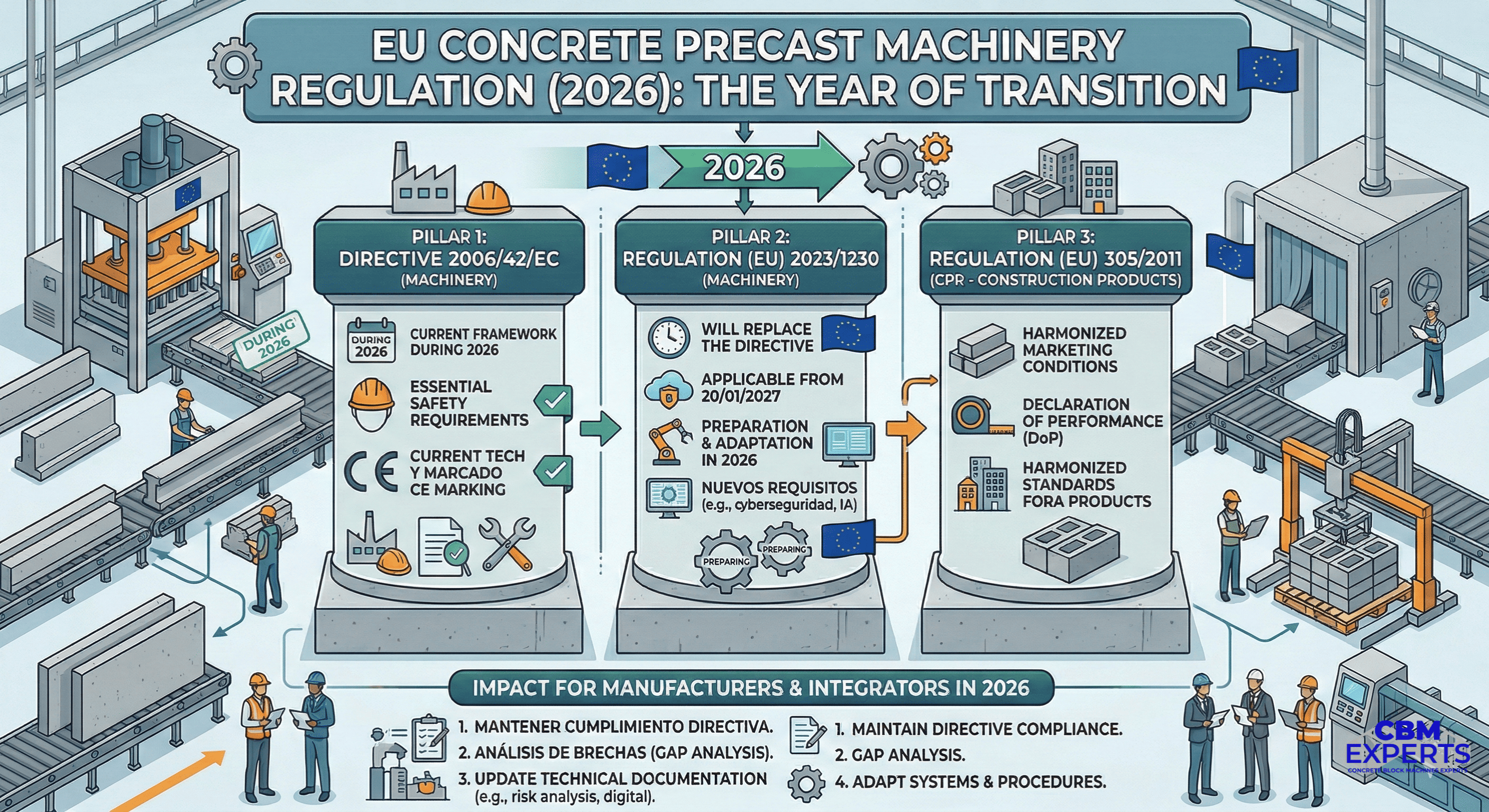
In 2026, the regulatory framework applicable to machinery for precast concrete in the European Union is based on three main pillars:
Directive 2006/42/EC on machinery (the legal framework in force during 2026).
Regulation (EU) 2023/1230 on machinery, which will replace the Directive and will apply from 20 January 2027.
Regulation (EU) 305/2011 (CPR), which lays down harmonised conditions for the marketing of construction products.
For manufacturers and integrators of industrial machinery —such as vibropresses, automated moulding lines, curing systems or palletising systems— 2026 is not a neutral year. It is a transitional regulatory period that requires full compliance with the current framework while simultaneously preparing processes, documentation and technical systems for the new Machinery Regulation.
This article explains which obligations remain applicable in 2026, what changes with Regulation (EU) 2023/1230, and how all of this affects machinery used in the manufacture of precast concrete elements.
Legal Framework Applicable in 2026
1. Directive 2006/42/EC (in force in 2026)
During 2026, Directive 2006/42/EC on machinery remains the primary legal framework for CE marking of industrial machinery within the European Union.
Official text available on EUR-Lex:
https://eur-lex.europa.eu/legal-content/ES/TXT/?uri=CELEX:32006L0042
This Directive establishes the essential health and safety requirements that a machine must meet before being placed on the market or put into service in the EU.
For regulatory purposes, a machine is defined as an assembly fitted with a drive system other than directly applied human effort, consisting of linked parts or components, at least one of which moves, and intended for a specific application.
For a manufacturer of precast concrete machinery, this entails:
Carrying out a risk assessment in accordance with the essential requirements.
Designing and implementing risk reduction measures.
Preparing a technical file demonstrating conformity.
Drafting appropriate instructions for use.
Issuing the EC Declaration of Conformity.
Affixing the CE marking to the machine.
These obligations are not merely formal requirements; they constitute the direct legal responsibility of the manufacturer or, in certain cases, the line integrator.
2. Regulation (EU) 2023/1230 on machinery
Regulation (EU) 2023/1230, published on 29 June 2023, replaces Directive 2006/42/EC.
Official text available on EUR-Lex:
https://eur-lex.europa.eu/legal-content/ES/TXT/?uri=CELEX:32023R1230
It will apply from 20 January 2027.
The key difference is legal in nature: while a directive requires transposition into national law, a regulation is directly applicable in all Member States.
Although the Directive remains the applicable framework in 2026, the Regulation introduces changes that directly affect manufacturers of industrial machinery, particularly where there is:
Integration of software or programmable systems.
Connectivity or remote updates.
Safety-related control systems.
Substantial modifications to existing machinery.
Among the most relevant aspects of the new Regulation are:
Greater clarity on what constitutes a substantial modification, understood as an alteration that changes the function or the risk level of the machine.
The possibility of providing documentation in digital format, under certain conditions.
Strengthened requirements relating to control systems and safety.
For manufacturers of precast concrete machinery, 2026 should be a year of review and gradual adaptation of internal processes, risk assessments and technical documentation, in preparation for mandatory application in 2027.
CE Marking in Precast Concrete Machinery: Real Implications on the Plant Floor
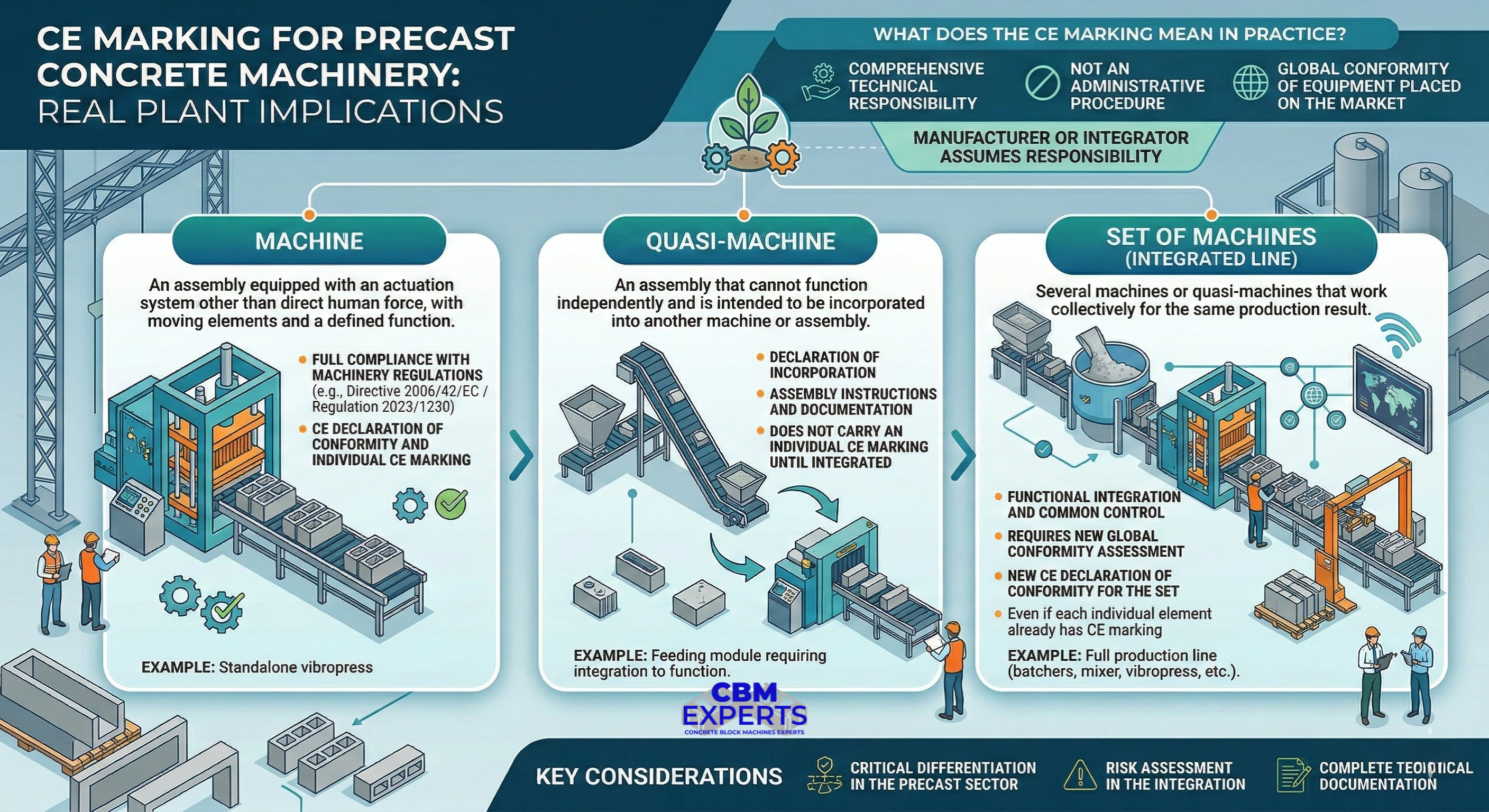
In the field of precast concrete machinery —such as vibropresses, automated moulds, feeding systems, curing systems, palletising systems or complete production lines— CE marking is not an administrative formality, but a comprehensive technical responsibility.
The manufacturer (or, in certain cases, the line integrator) assumes overall responsibility for the conformity of the equipment placed on the market.
Machine, partly completed machinery and complete line: key distinctions
The legislation distinguishes between different types of technical assemblies:
Machine: an assembly equipped with a drive system other than directly applied human effort, with moving parts and a defined function.
Partly completed machinery: an assembly that cannot function independently and is intended to be incorporated into another machine or assembly.
Assembly of machinery (integrated line): several machines or partly completed machinery arranged and controlled so that they function together to achieve a common production result.
In the precast sector, this distinction is critical. For example:
A vibropress sold as a standalone unit is a machine.
A feeding module that requires integration to operate may be considered partly completed machinery.
A complete line integrating batching systems, mixers, vibropresses, transport systems and palletising systems constitutes an assembly that may require a new overall conformity assessment.
Where functional integration and common control exist, there may be an obligation to issue a CE Declaration of Conformity for the assembly, even if each individual component already bears CE marking.
Responsibility of the Integrator
A common mistake in industrial environments is to assume that if all individual machines bear CE marking, the complete line automatically complies.
This is not always the case.
If an integrator:
Designs a common control architecture,
Modifies safety interlocks,
Reconfigures emergency stop systems,
Or alters the operation originally intended by the manufacturer,
they may become responsible for the conformity of the overall assembly.
This entails:
A new risk assessment.
Review of protective measures.
Updating the technical documentation.
Issuing a new Declaration of Conformity.
Substantial Modification: When Responsibility Changes
The concept of substantial modification becomes particularly relevant under Regulation (EU) 2023/1230.
A substantial modification is understood as an alteration that:
Changes the intended function of the machine, or
Increases its level of risk beyond what was originally assessed.
In precast plants, this may occur when:
A previously manual machine is automated.
A robot is integrated into an existing cell.
Control systems are replaced with programmable versions incorporating new logic.
Speed or capacity is increased without reassessing risks.
In such cases, there may be an obligation to repeat the conformity assessment process.
Common Harmonised Standards in Precast Machinery
To demonstrate compliance with the essential requirements of Directive 2006/42/EC (and, in the future, Regulation 2023/1230), manufacturers typically apply harmonised standards.
A harmonised standard is a European technical standard whose application provides a “presumption of conformity” with specific essential requirements.
In precast concrete machinery, the most commonly applied standards include:
EN ISO 13849 – Safety of Control Systems
This standard regulates the design of safety-related parts of control systems.
It is particularly relevant in:
Vibropresses with interlocking systems.
Emergency stop systems.
Automated lines with sensors and light curtains.
Robotic cells.
It defines concepts such as Performance Level (PL), architectural categories and reliability.
EN 60204-1 – Electrical Equipment of Machines
This standard applies to the electrical aspects of machinery, including:
Electrical panels.
Protection against direct and indirect contact.
Emergency circuits.
Identification and wiring.
In precast production lines with high power demand and harsh industrial environments, this standard is essential.
EN ISO 14120 – Guards
This standard regulates the design and construction of fixed and movable guards.
It is fundamental in:
Vibration zones.
Moving parts of conveyors.
Moulding and compaction systems.
EN ISO 13850 – Emergency Stop
This standard establishes the functional requirements for emergency stop devices, which must:
Be easily accessible.
Have priority over other functions.
Not replace other protective measures.
In the context of precast concrete manufacturing—where there are high-mass movements, intense vibration and rapid automated cycles—the correct application of these standards is not merely formal; it directly determines the operational safety of the plant.
Regulation (EU) 305/2011 (CPR) and Its Indirect Impact on Precast Machinery
Regulation (EU) 305/2011, known as the Construction Products Regulation (CPR), lays down harmonised conditions for the marketing of construction products within the European Union.
Official text available on EUR-Lex:
https://eur-lex.europa.eu/legal-content/ES/TXT/?uri=CELEX:32011R0305
Although this Regulation does not directly govern machinery, it indirectly affects manufacturers of equipment for precast concrete production.
Why?
Because many precast concrete elements are covered by European harmonised standards and require:
CE marking of the product.
Issuance of a Declaration of Performance (DoP).
Implementation of a Factory Production Control (FPC) system.
In this context, the machinery used in manufacturing becomes a critical factor in ensuring the constancy of performance of the final product.
EN 13369 and the Common Framework for Precast Products
EN 13369 establishes the common rules applicable to precast concrete products.
Many sector-specific standards (such as those relating to hollow-core slabs, beams, structural elements or blocks) refer to it as their technical foundation.
Among other requirements, it establishes:
Control of raw materials.
Control of the manufacturing process.
Dimensional verification.
Testing and documented records.
Traceability.
This means that the precast manufacturer must be able to demonstrate that its production process is stable and repeatable.
And this is where machinery becomes essential.
Factory Production Control (FPC): What It Means for Machinery
Factory Production Control (FPC) is a documented system that ensures the manufactured product maintains the declared performance.
From the perspective of a machinery manufacturer, this implies that equipment must enable:
Repeatability of production cycles.
Precise adjustment of parameters (time, vibration, compaction, dosing).
Recording of critical variables.
Batch or serial traceability.
Dimensional stability of the final product.
Although the CPR does not require machinery manufacturers to certify their equipment under this Regulation, in practice the client (the precast producer) will expect the equipment to facilitate compliance with FPC requirements.
During product audits, it is common for authorities or notified bodies to review:
Manufacturing parameters.
Historical records.
Documented procedures.
Calibrations.
If the machinery does not allow adequate control and recording, the precast manufacturer may face difficulties in maintaining CE conformity of its product.
Key Distinction: Machinery vs Construction Product
It is important to clarify:
Machinery is certified under machinery legislation (Directive 2006/42/EC or Regulation (EU) 2023/1230).
The precast product is certified under Regulation (EU) 305/2011 and its applicable harmonised standard.
These are distinct legal frameworks, but they are technically interconnected.
In 2026, this interconnection is becoming increasingly evident due to:
Stronger documentation requirements.
Digitalisation of processes.
Integration of control and traceability systems.
More structured audits in large projects and infrastructure works.
For industrial machinery manufacturers, understanding this relationship is not optional; it forms part of their technical positioning when dealing with demanding clients.
What a Precast Machinery Manufacturer Should Review in 2026
In 2026, regulatory compliance in industrial machinery is not solved by simply “having CE marking.” The key is that conformity must be defensible: technically robust, properly documented and aligned with the changes that will enter into force in 2027 under Regulation (EU) 2023/1230.
The following are the main areas worth reviewing (and those that most often generate issues during inspections, audits or complex integrations):
1) Risk assessment: review it, do not archive it
A risk assessment is not a “handover document”; it must remain consistent with the actual machine, its intended use and its installation conditions.
In precast machinery, the context of use often changes due to:
Variations in production rate.
Changes in plant layout.
Automation adjustments.
Integration with conveyors, robots or palletisers.
When a machine is integrated into a line or its control logic is modified, the risk assessment should be updated to reflect the new situation, rather than remaining in its original version.
2) Clearly define the scope of conformity (machine vs line)
One of the most costly mistakes in the sector is failing to clarify who is responsible for the conformity of the assembly:
If you sell a standalone machine → the scope is clear.
If you sell modules and perform integration on site → you may become responsible for the assembly.
If you deliver a complete line with common control and integrated functionalities → conformity is typically global.
This directly affects:
The Declaration of Conformity.
The technical file.
The instructions and limitations of use.
The safety architecture of the system.
3) Safety-related control systems (software and logic)
In automated precast lines, many safety functions depend on the control system: interlocks, emergency stops, sensors, guarded access with locking, reset logic, etc.
In 2026, what matters most is consistency between:
The safety design (e.g., EN ISO 13849).
The actual implementation (PLC, relays, sensors, HMI).
The documentation (specifications, testing, validation).
In simple terms: the system must be both safe and demonstrably safe.
4) Technical documentation: prepare it for digital transition
Regulation (EU) 2023/1230 reinforces the documentation framework and allows digital formats under certain conditions, which pushes manufacturers to professionalise how documentation is managed:
Manual versions.
Change history.
Technical data sheets.
Electrical schematics.
Safety validations.
Configuration traceability.
If in 2026 your documentation relies on isolated PDFs without version control, you are exposing yourself to risk in serious projects—especially where field software updates are involved.
5) Parameter traceability: increasingly less “optional”
Although the CPR regulates the construction product, in practice precast manufacturers must demonstrate constancy in production (FPC).
For this reason, more and more clients will value—or require—that machinery allows:
Recording of critical parameters per cycle or batch.
Exporting historical data.
Defining recipes and tolerance-based lockouts.
Integration with SCADA/MES systems.
This not only improves client compliance; it reduces incidents and accelerates diagnostics.
6) After-sales and on-site changes: controlling “substantial modifications”
After-sales activities are a common source of silent non-compliance: urgent changes, adjustments “to make it run better,” replacement of critical components or modifications in programming.
In 2026, it is advisable to establish minimum discipline regarding:
Which changes are permitted without reassessment.
Which require safety validation.
When a modification may be considered substantial.
How such changes are documented.
This protects you legally and prevents the CE marking of the machine from becoming indefensible over time.
Frequently Asked Technical Questions (FAQ)
Is CE marking mandatory for precast concrete machinery?
Yes. If a machine is placed on the market or put into service in the EU, it must comply with the applicable machinery legislation and bear CE marking. In 2026, the base framework remains Directive 2006/42/EC, until Regulation (EU) 2023/1230 becomes the sole applicable framework from 20 January 2027.
What exactly changes with Regulation (EU) 2023/1230 and why does it already matter in 2026?
The regulatory approach changes (from a Directive to a Regulation, directly applicable across the EU) and it reinforces aspects particularly relevant to modern machinery: documentation, control systems, digital technologies, and clarity regarding responsibilities when significant changes are made. Although it applies from 2027, aligning documentation and design in 2026 avoids having to redo work later.
Does used machinery need to “adapt” to the new Regulation?
It depends on the situation. A used machine is not automatically “recertified” simply because a new regulation exists. However, if a significant modification is made (especially one that changes the function or risk level) or if it is integrated into a line with common control in a way that alters the assembly, a new conformity responsibility may arise (typically for the party modifying or integrating it). The new Regulation places particular emphasis on these situations.
If I integrate several machines into one line, who is responsible for the CE marking of the assembly?
If there is real functional integration (common control, shared safety logic, interlocks, emergency stops, etc.), it is not sufficient that each individual machine has CE marking. The assembly may require its own conformity assessment and documentation. The Machinery Directive application guide addresses these cases and responsibilities in detail.
What documentation must actually exist for CE marking to be defensible?
At a minimum, there must be a coherent chain between:
Risk assessment
Implemented protective measures
Applied harmonised standards (where relevant)
Technical file
Instructions/manuals
Declaration of Conformity
This is not theoretical; it is what is reviewed during audits, incidents or inspections. Sector guidelines can be helpful, although they do not replace the legal text.
Why is CPR 305/2011 relevant if I manufacture machinery, not precast products?
The CPR regulates the construction product (the precast element), but it obliges the product manufacturer to ensure constancy of performance and production control. In practice, this drives the need for machinery that enables repeatability, traceability, data recording and parameter control, because the precast manufacturer must provide evidence within its production system.
Conclusion
In 2026, if you manufacture or integrate machinery for precast concrete production, regulatory compliance can be summarised as follows:
You comply in 2026 with Directive 2006/42/EC (CE marking, risk assessment, technical file, manuals, declaration).
You prepare in advance for Regulation (EU) 2023/1230, which will become the sole applicable framework from 20 January 2027.
You understand that, although CPR 305/2011 does not regulate your machine, it conditions what your client must demonstrate regarding the product (FPC, traceability, repeatability).
You avoid the common sector mistake of thinking that “having CE” is just a label. It is a technically and legally defensible system.
Technical Conformity Review for Machinery Manufacturers
At CBM Experts, we provide specialised regulatory compliance support for industrial machinery in the precast sector.
We offer:
CE marking audits
Review of integrations and complete production lines
Risk assessment in accordance with applicable legislation
Preparation for Regulation (EU) 2023/1230
If you are planning new installations or reviewing existing machinery, a preventive technical review can help avoid unnecessary costs and liabilities.